
bankaustria-kunstforum.at - You are on page "MARKUS LÜPERTZ | Review | Bank Austria Kunstforum"
Use following links for navigation.
Choose language
Search
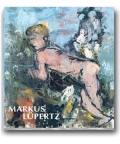
MARKUS LÜPERTZ
September 6th 2006 - November 5th 2006
Markus Lüpertz is one of the figureheads of an art that despite all vaguaries of dogma and fashion always adheres to the "traditional" panel painting, which has so often been declared dead. His pictures are always witness to an enormous vitality and power – in the charged field between monumental earthing and fine ornamentation, in connection with the timeless beauty of classical painting.
In the early sixties when he started his career as a painter, Lüpertz saw himself confronted with the dominant art trends – figurative pop-art and abstract expressionism. His answer to both lies in the seemingly incompatible synthesis of pictorial motif and abstraction: Lüpertz calls his abstract compositions "dithyrambs", with reference to the ancient deities of the same name, who stand for the transgression of two phases of life following on from each other, "heads of Janus", as it were. This complex duality of "not only, but also", of the "in between", today
forms the conceptional basis of Markus Lüpertz's art. However, he has produced work blocks in which he tends towards narrative and concrete treatment of motifs, above all in his works with "German motifs" from the
early seventies (NS steel helmet, canons, Wehrmacht greatcoats, antlers and wheat field), or in numerous paraphrases from the 1980s of Nicolas Poussin's paintings. Yet Lüpertz has no desire to illustrate stories on the
canvas, let alone moralise, but faces the challenge of "charging loaded themes" in paint, or converting the compositional strategies of the "old masters" from Poussin to Cézanne and Picasso with his stylistic means.
He sees himself as an "abstract painter", without having to be bound to the strict, technical guidelines of non-objective painting.
- -
- -
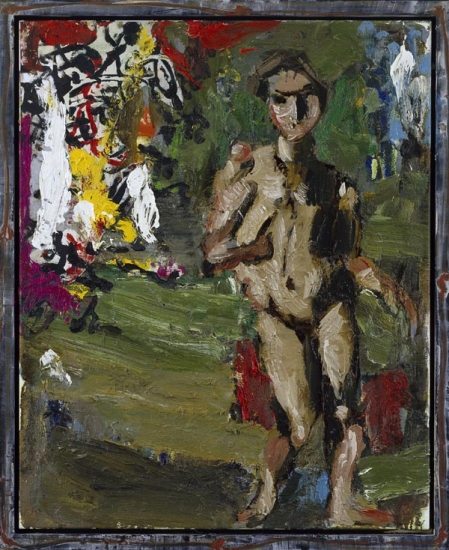
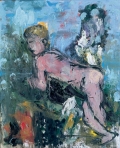 ©Markus Lüpertz: Nach Marées - Gelber Kopf, 2002
© Markus Lüpertz, Courtesy Galerie Michael Werner, Köln und New York - -
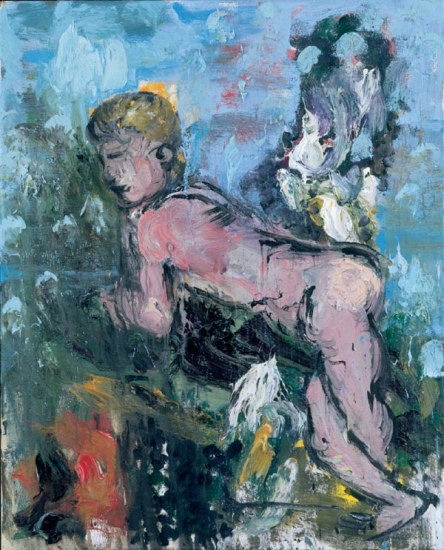
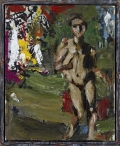 ©Markus Lüpertz - Nach Marées- Vision, 2002
© Markus Lüpertz, Courtesy Galerie Michael Werner, Köln und New York - -
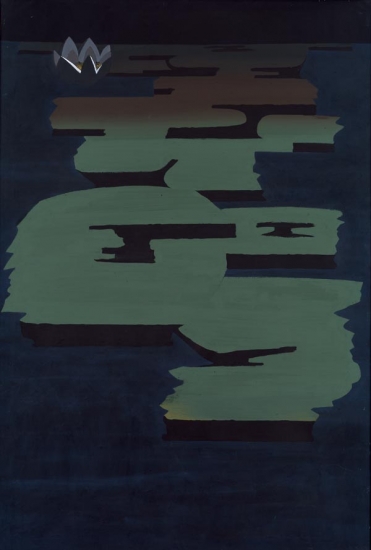
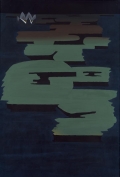 ©Markus Lüpertz - Seerose, 1970
© Markus Lüpertz, Courtesy Galerie Michael Werner, Köln und New York - -
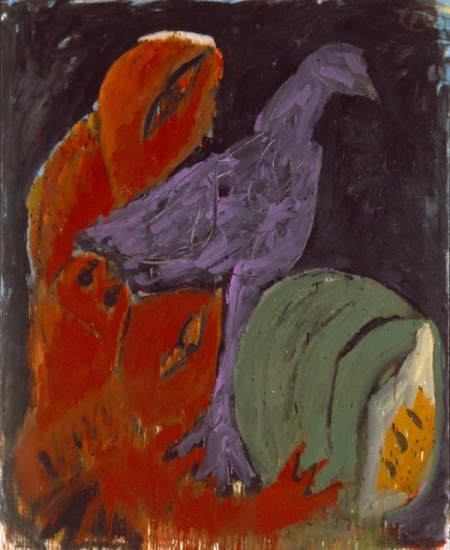
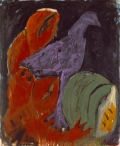 ©Markus Lüpertz - Zwischenraumgespenster: Violetter Vogel, 1987
© Markus Lüpertz, Courtesy Galerie Michael Werner, Köln und New York
- - Back
Menü
Aiwasowski - Maler des Meeres 17.03.2011 – 10.07.2011
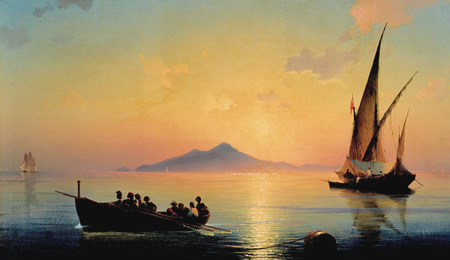
Ivan Konstantinovitch Aivazovsky, Golf of neapel,1841
© The Peterhof State Museum-Reserve, St. Petersburg, 2010 (detail)